

By Jeff Copper, MBA, PCC, PCAC, CPCC, ACG – September 7, 2026
 Stop calling yourself disorganized… your ADHD brain already has a system. If you have ADHD, chances are you’ve said something like:
- “I’m so disorganized.”
- “I’m a mess.”
- “I just need a better system.”
As an ADHD coach, I hear those statements all the time. My response often surprises people:
“You’re probably already organized. You just don’t recognize the system you’re using.” So, before you throw out everything and search for the latest planner, app, or productivity method, it’s worth asking a different question: What system are you already using—and why does it work the way it does?
You can’t improve a system until you understand it. When people come to me for coaching, they often expect me to help them build an entirely new organizational system. Instead, the first thing I do is map out their current one.
This isn’t unique to ADHD coaching. It’s the same approach industrial engineers use when improving a manufacturing process. Before making changes, they study the existing workflow to understand what’s happening at every step. The same principle applies to ADHD. Even if your system feels chaotic, there is usually a reason it evolved that way.
I once worked with a highly successful real estate agent who constantly felt anxious because she believed she wasn’t organized enough. She assumed she needed to start using her company’s customer relationship management (CRM) system. But she never used it. Why? Because entering client information was repetitive, tedious, and boring—all tasks that are particularly difficult for many people with ADHD.
Rather than forcing herself into a system she resisted, we examined what she was already doing. She realized that:
• New clients contacted her through texts or phone calls.
• Those messages naturally became a record of her prospects.
• She reviewed her texts and voicemail every day.
• Older messages served as visual reminders to follow up.
• She wrote notes whenever she needed to complete a specific task.
In other words… the real problem wasn’t organization. she already had an organizational system. As we looked closer, something became obvious. Clients weren’t slipping through the cracks. The real issue wasn’t organization—it was anxiety.
She simply wanted a way to see all of her active clients at once instead of scrolling through messages on her phone. That required only one small accommodation. A simple visual solution.
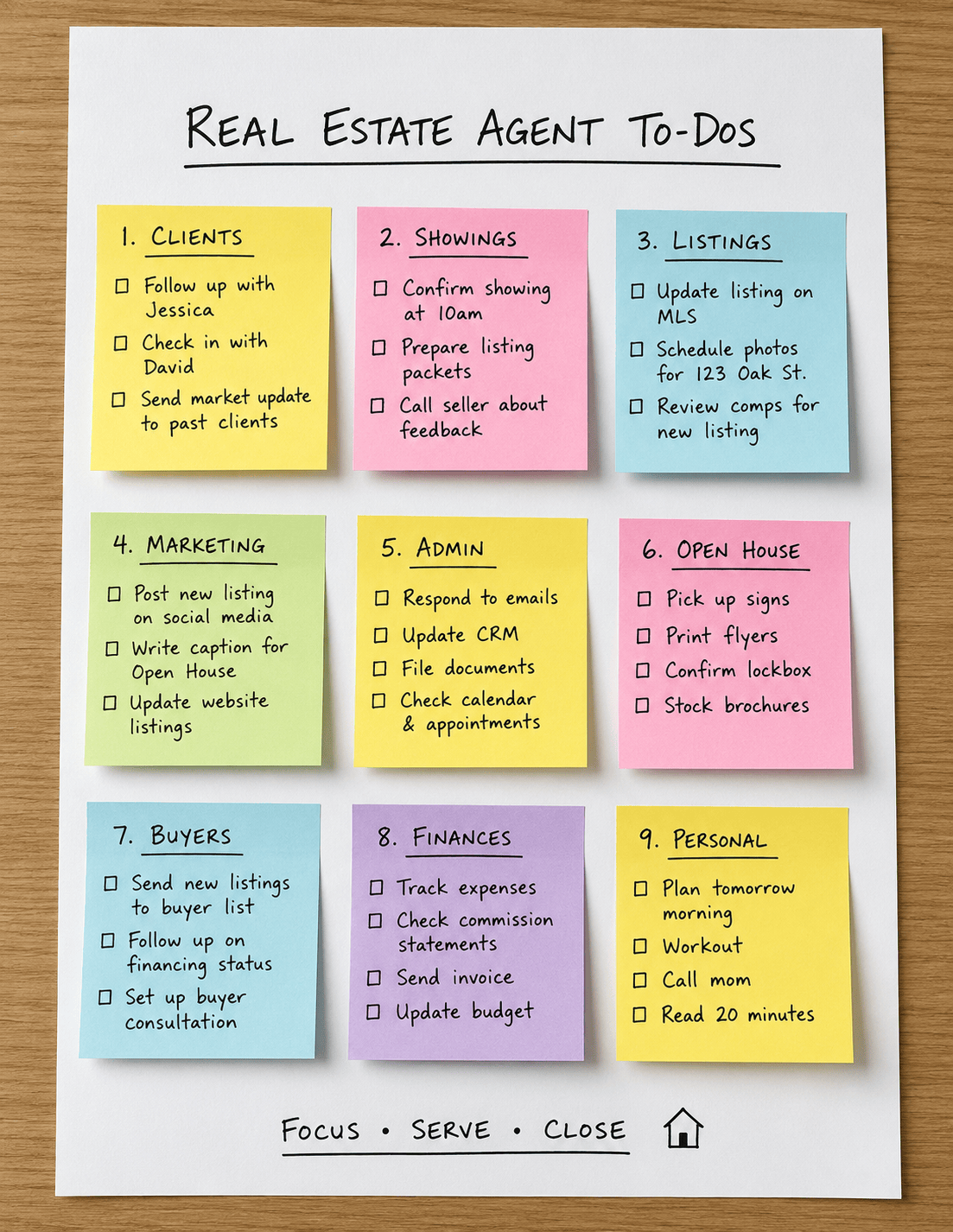
Instead of adopting an entirely new CRM, we created a simple visual overview. Each client was written on a single Post-it Note and placed on a sheet of paper. As clients progressed, their notes could be moved, removed, or replaced. We even discussed experimenting with different colors to represent various stages of the buying process.
The goal wasn’t perfection. The goal was creating an external visual representation that complemented the system she already used successfully. Small tweaks beat complete overhauls. Many people with ADHD believe they need to reinvent how they organize their lives.
In reality, completely replacing a system often creates new problems.
Learning a brand-new process requires significant executive functioning:
• Remembering each new step
• Holding the process in working memory
• Stopping to think before every action
• Repeating it long enough for it to become a habit
That’s a tremendous amount of mental effort. It’s one reason so many planners, apps, and organizational methods are abandoned after only a few weeks. Sometimes success doesn’t come from replacing your system. It comes from making one thoughtful adjustment.
If you think you’re disorganized, try this exercise. Start by mapping what you already do. Instead of asking, “What new system do I need?” Ask:
• How do I currently keep track of things?
• What reminders am I already relying on?
• What parts actually work well?
• Where do I experience stress or anxiety?
Once you can see your existing system, you’ll often discover that you don’t need to rebuild it.
You simply need to strengthen the parts that aren’t serving you. The bottom line is that, if you’re alive and functioning, you’re already organized in some way.
Your ADHD brain has developed systems—some intentional, some accidental—to help you navigate daily life. The key isn’t to erase those systems. It’s to understand them. When you identify what’s already working and make strategic accommodations where needed, organization becomes far more achievable—and much less overwhelming.
Before searching for the next productivity tool, map your current system first. You may discover you’re much more organized than you think. To learn more, watch my Attention Talk Video, Hocus Pocus: Finding Your System in ADHD Chaos.
TRANSCRIPT:
Welcome everybody to this edition of Attention Talk video. I’m your host ADHD and attention coach Jeff Copper and today I’m here to talk about organization and actually kind of witnessing your organization.
Most people with ADHD say, “I’m disorganized, I’m a mess,” and I say, “No, you actually are organized and you do have systems. The first thing that you have to do is you have to map out your current system and you have to look at your system and say why is my system the way that it is?” It can reveal a lot of really important things.
I’m gonna give you an example here today, and I’m gonna do the best I can ’cause I’m covering a lot of material, but I was working with a real estate agent who did very well, I might add, but always had some anxiety, and “I gotta get a better system.”
I said, “Well, let’s think about your system. What do you do?” Basically, she gets leads from people texting her or making phone calls. So, that text comes in and that lead comes in, and what she does is she responds to them. “Can I help you,” or “Can we get on the phone to have a conversation about whatever it is?”
So, she actually has a record of all of her clients by those that are texting her or that she has a voicemail for. It’s a record. She typically gets on the phone and has a conversation with them and has a pretty good idea after she’s had conversations with her. She can recall that relatively well. And if she’s got something to do, like she’s got to go back and look on MLS to get a couple properties, she writes a note, And she goes and does that, and she comes up with some property. She takes the people out and goes and does whatever.
As I began to talk to her about this, I began to ask, “Well, really, what system do you want?” Well, her real estate company had a CRM, which is a customer relationship management system. There’s different types, and she’d never used it. I talked to her about that, and like, “Well, why wouldn’t you use it?”
“Well, entering all that data is a repetitive and boring task.” Classic characteristics for procrastination for ADHD. So, let’s not go do that because it’s not working, because it’s too much effort to put that in. So, then I began to talk to her, “Well really, if you had it in there, what would you do it for?
“Well, I could have an idea of what’s outstanding in terms of my client base and stuff like that.
I said, “Well, let’s think about this. Do you have any of these things that fall through the cracks?” So, basically, she said no. And we began to talk about her industry. She’s a residential real estate person who’s very reactive, like, somebody in Ohio wants to buy a house in Georgia. You get a phone call that they’re coming in and you gotta go take them out and show them a bunch of houses. You’re kinda like the flea on the tail end of the dog. It’s a very reactionary thing and very, very chaotic.
And so, as we began to talk our way through this, we began to realize that her system actually was really pretty good ’cause basically every day she’d go through her phone and she would scroll down and look at all the texts. “I need to follow up with these guys. I haven’t…” you know, whatever, or scroll through her voicemails and she would recognize,”Oh, I need to… this is a couple days old. Maybe I should follow up.”
So, you’ll notice that she had a record. She had a visual trigger reminder about the things were outstanding and the ones that were a couple days old and she would follow up with them. So, there was a prioritization in this somewhere that was actually working. Now, some days were really, really busy and maybe she’d get these things, but she couldn’t and other days were slow. But her system, a very visual, which is really good for people with ADHD, of what’s going on, actually was there.
As we got through it, really what she needed was she just needed a bigger picture to understand what was outstanding. So, putting our little thinking caps on to make this real easy, she could write down a list, but then she’d have to scratch it off, and that just gets kind of crazy. So, what we decided to do was just go through and put the name of each prospect on a Post-It. just one Post-It and stick the Post-It on a sheet of paper, like on a sheet of paper where there’s just a bunch of Post-Its. And she could actually move them around.
Somebody sells a house or they buy a house, she takes them off or adds somebody on. But she had a record, and the cool thing about sheets of paper like this, she could roll them up and put a rubberband around them to make them nice and convenient.
Here’s the moral of the story, is that after we went through and took a look at her existing system… Let me back up, she wanted to get more organized, But we didn’t need to. We went through and mapped out her current system, began to realize how it worked, why it worked the way it did, why she wasn’t using the CRM at work. And we said, well, really, what’s at issue here?
“It’s the anxiety. I need to see all my clients all at one time.” And we just put the name on Post-Its on a sheet of paper. Now, just so you know, we’re exploring a couple ideas is to have different color Post-Its to signify they’re in different stages. So, let’s say a green would be somebody’s about to buy; yellow or maybe red is somebody’s just starting the process. Of course, every time they go from one color to the other color, you got to rewrite the name on it, which might be too much work, but we don’t really know. We’re going to figure this stuff out.
The reason I’m doing this video with you is that, if you feel like you’re disorganized, if you’re coming to me for coaching, the first thing I do is I map out what you’re currently doing, which is what industrial engineers do first in a production facility if they’re going to try to make it more efficient. What we do is we map out what you’re doing first. We take a look at those touch points and we make some adjustments.
And so, I hope this was a little bit of a tangible example of what that would look like. Certainly, it might be a little bit overwhelming to you because your situation might be a little bit differently, but I did want to give you the concept of you’d be dead if you weren’t organized. You do have some systems in place, even if you’re relying on other people, but if you map them out first and understand why, usually what I find, we just have to tweak those systems a little bit, not reinvent them, which by the way, to come up with a completely new system, realizes that it’s going to be a challenge because number one it’s going to tax your working memory because, from a self-regulation perspective, you have to stop and think about what you’re going to do each time… stop and think and stop and think and developing new habits and new systems is very, very effortful, which is why you start them and you never get into them because you never really reprogram your brain.
Okay so, that being said, I hope this was useful and helpful. Please subscribe to our channel by hitting our SUBSCRIBE button right here. Leave comments on what you think. Maybe even if some of you go out there and map out your current system, let me know how that works. We hope you’ve enjoyed this edition of Attention Talk Video. Take care.